Few contemporary films walk the razor’s edge between ambition and despair as boldly as Magazine Dreams. Written and directed by Elijah Bynum, the film unfolds as an unflinching psychological portrait of Killian Maddox, an amateur bodybuilder whose single-minded pursuit of greatness becomes both his aspiration and his undoing. It is a story about the hunger for validation, the invisible wounds of loneliness, and the dangerous extremes to which people may go to be seen, heard, and admired.
Emerging from Sundance with critical acclaim, Magazine Dreams was quickly positioned as one of the most haunting character studies of recent years. Yet the film’s release became entangled in an unusually dramatic industry context: cultural debates about masculinity, ongoing scrutiny of celebrity behavior, the effects of body dysmorphia in American culture, and controversies involving its lead actor, Jonathan Majors. This complex backdrop only amplifies the film’s themes, giving Magazine Dreams a sense of urgency far beyond the screen.
This article examines the film in detail—its narrative construction, character psychology, genre influences, stylistic ambitions, and cultural significance—while also exploring how its production and release history became inseparable from the public discourse surrounding it.
A Character Study Wrapped Inside a Societal Mirror
The World of Killian Maddox
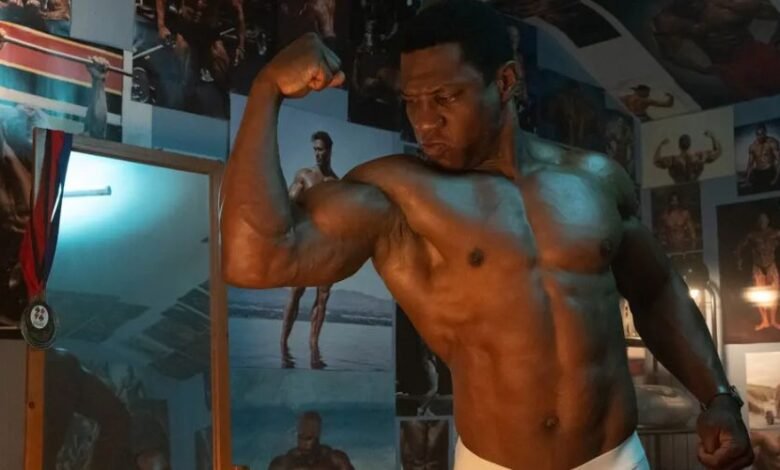
At the heart of Magazine Dreams lies Killian Maddox, portrayed with harrowing commitment by Jonathan Majors. Killian is a grocery store employee by day and a furious, solitary bodybuilder by night. His life revolves around training regimens, strict diets, steroid injections, posing practice, and stacks of bodybuilding magazines featuring his idols.
What might appear at first to be merely the life of a dedicated athlete quickly reveals its cracks. Killian is not driven by a balanced passion; he is driven by a painful void. His desire to become an icon on the cover of bodybuilding magazines is intertwined with his desire to be acknowledged, loved, and respected in a world that has largely ignored him.
The film uses bodybuilding as a lens through which to examine perfectionism, self-worth, and the fragile line between discipline and obsession. Killian is in constant pursuit of a physical ideal, yet every accomplishment brings him no joy—only the anxiety that he must push further or he will never be enough.
Body Dysmorphic Disorder as a Narrative Core
One of the most striking aspects of Magazine Dreams is its portrayal of body dysmorphic disorder, a mental condition in which individuals fixate on perceived flaws in their appearance. Killian’s obsession is not merely vanity; it is a suffocating psychological cage.
He sees himself as small, inadequate, and unworthy, no matter how massive his muscles become. Every rep is fueled by his desperation to erase his insecurities, but every rep also deepens them. Bynum avoids glamorizing the bodybuilding world, instead painting its darkest corners: the pressure to be bigger, the reliance on dangerous substances, and the emotional isolation that can develop around hyper-focused self-improvement.
Killian’s body becomes a battleground—both his armor and his vulnerability. His transformation is physical, psychological, and tragic.
Themes: Obsession, Masculinity, Loneliness, and the Need to Be Seen
The Tragedy of Unfulfilled Recognition
Killian’s struggle is shaped by a deep hunger for recognition. He sends earnest, rambling fan letters to his bodybuilding hero, Brad Vanderhorn. He imagines being praised on stages and magazine covers. He believes fame will fill the cracks inside him.
Yet the world never acknowledges him. Competitions don’t go his way. Social interactions are clumsy and painful. Even those few who show him kindness do not fully understand his inner torment.
This recurring pattern—that Killian gives everything and receives nothing in return—builds a slow, suffocating tension. His loneliness is crushing, and his attempts at connection repeatedly fail, pulling him further into emotional instability.
American Masculinity Examined Through Extremes
In many ways, Magazine Dreams is a critique of how American culture defines and pressures masculinity. The film exposes a world in which young men are encouraged to chase strength, dominance, and image while discouraged from expressing fear, vulnerability, or confusion.
Killian is both a product and a victim of these ideals. He believes that becoming physically enormous will make him powerful. That being admired will confirm his worth. That suffering silently is a virtue.
But his inability to express his pain or ask for help becomes central to his downfall. His silence is not stoic—it is suffocating. The film invites viewers to examine how societal expectations around masculinity can warp self-identity and foster dangerous behaviors.
Loneliness as a Villain
Though Magazine Dreams features intense physical imagery and emotional volatility, its true antagonist is loneliness. The film portrays loneliness not as background texture but as a living force that distorts Killian’s perception of himself and the world.
His attempts to forge connections—with a co-worker, with fellow bodybuilders, with his idol—are heartbreaking precisely because they reveal how desperately he wants to belong. Yet every attempt is either awkward, misunderstood, or painfully misaligned with social norms.
His loneliness makes him vulnerable. It also makes him dangerous. It clouds his judgment and blurs the line between ambition and delusion.
Plot Structure: The Slow Descent into Desperation
Early Acts: Establishing the Pattern of Isolation
The early parts of Magazine Dreams focus on Killian’s routines. His workout sessions are brutal. His social interactions at work are strained. His therapist tries to reach him, but emotional suppression is all he knows.
The viewer begins to see the escalation: increased steroid use, worsening health problems, failure in competitions, and an intensifying sense of alienation.
This slow pacing mirrors Killian’s psyche—methodical, obsessive, and spiraling.
The Middle: A Longing for Connection
One of the most emotionally wrenching sections of the film involves Killian’s attempt to start a relationship with a co-worker named Jessie. Their interactions are tender but painfully awkward. Killian’s lack of social understanding becomes evident, and his desperation overwhelms the fragile possibility of connection.
These scenes serve as a reminder that beneath his imposing exterior lies a vulnerable, frightened man who wants love but doesn’t know how to reach for it.
When this budding relationship collapses, Killian’s sense of hope collapses with it. It is one of the pivotal moments that accelerates his psychological unraveling.
Final Act: Breakdown and Delusion
As the story progresses, Killian’s physical health deteriorates, and his mental state becomes dangerously unstable. His fantasies and realities begin to blur. He lashes out verbally and physically, fueled by frustration and grief.
One of the film’s most powerful elements is its refusal to offer a clean, triumphant arc. There is no simple redemption, no heroic victory. Instead, the narrative becomes an intimate chronicle of a mind under unbearable strain.
The final act lands with emotional devastation, leaving viewers questioning the societal structures—and personal traumas—that allow people like Killian to slip unnoticed into darkness.
A Stylistic Approach Rooted in Grit and Vulnerability
Visual Language
The cinematography of Magazine Dreams is gritty, intimate, and often claustrophobic. Adam Arkapaw’s camera emphasizes the tension between the massive physicality of bodybuilding and the emotional fragility of the central character.
Low-key lighting, tight framing, and saturated reds and browns create a sense of compression and unease. Many scenes feel intentionally uncomfortable, reflecting Killian’s internal claustrophobia.
Tone and Influences
The tone of the film draws comparisons to psychological dramas like Taxi Driver and Joker, where alienated protagonists navigate hostile environments while battling their own deteriorating minds.
But Magazine Dreams avoids becoming an imitation. Its focus on body dysmorphia and the subculture of bodybuilding gives it a unique identity within the genre. Its pacing is more meditative, its violence more psychological than explosive, its emotional beats more quietly tragic than sensationalized.
Jonathan Majors’ Performance
Majors delivers a towering performance—raw, vulnerable, and physically transformative. His portrayal carries the entire film, embodying the contradictions of Killian’s character: the imposing physique and the fragile insecurities, the rigid discipline and the emotional volatility.
Even amid real-world controversies, Majors’ work in this film is frequently cited as one of the most haunting lead performances of the decade.
Reception and Cultural Impact
Critical Response
Critics praised the film for its intensity, honesty, and atmospheric storytelling. The performance at Sundance set high expectations. Reviews consistently highlighted Majors’ commitment, calling it both mesmerizing and difficult to watch.
Many reviewers found the film’s depiction of obsession and isolation both truthful and unsettling. Its willingness to confront uncomfortable subjects—mental illness, self-destruction, and toxic masculinity—distinguished it from more conventional dramas.
The Complicated Release Journey
Magazine Dreams underwent a highly unusual and troubled path to release. After its Sundance success, a major studio initially acquired the film, planning a widespread theatrical debut. However, external controversies involving Majors led to the film being pulled from the studio’s calendar.
Eventually, the rights returned to the filmmakers, and a different distributor took on the project, leading to a delayed release years after its festival debut. This unusual trajectory became a major talking point, coloring public perception of the film and raising questions about the separation of art from artist.
Box Office and Audience Response
Despite critical acclaim, the film’s box office performance was modest. Part of this can be attributed to its heavy themes and emotionally intense narrative, but the release complications also played a significant role.
Audience reactions tended to mirror the critical response: praise for the performances and thematic depth; caution about the film’s disturbing emotional weight. For many, Magazine Dreams is not easy viewing, but it is undeniably resonant.
Why Magazine Dreams Matters
A Study of Modern Isolation
At a time when loneliness is increasingly recognized as a major societal issue, Magazine Dreams offers a chillingly realistic depiction of how emotional isolation can manifest in extreme, harmful ways. Killian is not a caricature; he is a hauntingly familiar figure in modern culture—ambitious yet insecure, disciplined yet unstable, desperate for connection yet unable to achieve it.
A Critique of Image Culture
The film also speaks to the overwhelming pressure of modern image culture. Social media, fitness influencers, and celebrity idolization have intensified the idea that worth is measured by physical perfection or public recognition. Killian’s obsession is only an exaggerated reflection of the pressures many face today.
A Reminder of the Hidden Battles People Fight
Perhaps the most important message of Magazine Dreams is that people often carry invisible struggles—struggles that can spiral when left unaddressed. It is a film that encourages empathy by showing how easily someone can fall through the cracks when they lack support, understanding, or a healthy sense of self.
Frequently Asked Questions (FAQs)
What is Magazine Dreams about?
Magazine Dreams follows Killian Maddox, a struggling bodybuilder who becomes increasingly obsessed with achieving fame and validation. The film explores themes of obsession, loneliness, mental health, and the pressures of modern masculinity.
Is Magazine Dreams based on a true story?
No, the film is fictional. However, many of its themes—such as body dysmorphia and the culture around professional bodybuilding—are grounded in real societal issues, giving the story a powerful sense of authenticity.
Why was the release of Magazine Dreams delayed?
The film’s release was delayed due to external circumstances involving its lead actor and shifting decisions by studios regarding distribution. Ultimately, the rights returned to the filmmakers, and a new distributor released it later than originally planned.
What makes Jonathan Majors’ performance stand out?
Majors brings an intense physical and emotional commitment to the role. His portrayal captures both the imposing exterior and the emotional fragility of Killian Maddox, making his performance one of the most memorable aspects of the film.
Is Magazine Dreams suitable for all audiences?
The film deals with heavy themes—mental illness, self-harm, obsession, and emotional breakdown. Its tone is intense and can be emotionally challenging. Viewers should be prepared for a psychologically heavy experience.